
Seasonal Allergies: A Study in Load, Barrier, and Flow
Supporting the body, rather than working against it
Seasonal allergies are typically framed as an immune system overreaction—
a heightened response to otherwise harmless environmental particles.
And while this is true, it is incomplete.
What determines the intensity of that response is often less about exposure alone,
and more about the condition of the system receiving it.
When inflammatory load is elevated,
when mucosal and skin barriers are compromised,
and when fluid movement is sluggish—
the same exposure produces a very different experience.
Congestion deepens.
Pressure builds.
Reactivity increases.
The body is not failing.
It is attempting to process more than it can efficiently clear.
Seasonal allergies are not simply about what you’re exposed to—
but how well the body can process, regulate, and clear it.
Where Support Becomes Meaningful
01 — Modulating the Histamine Response
Histamine is central to allergy symptoms—responsible for swelling, itching, and increased mucus production.
Supporting this process does not require suppression,
but rather gentle modulation over time.
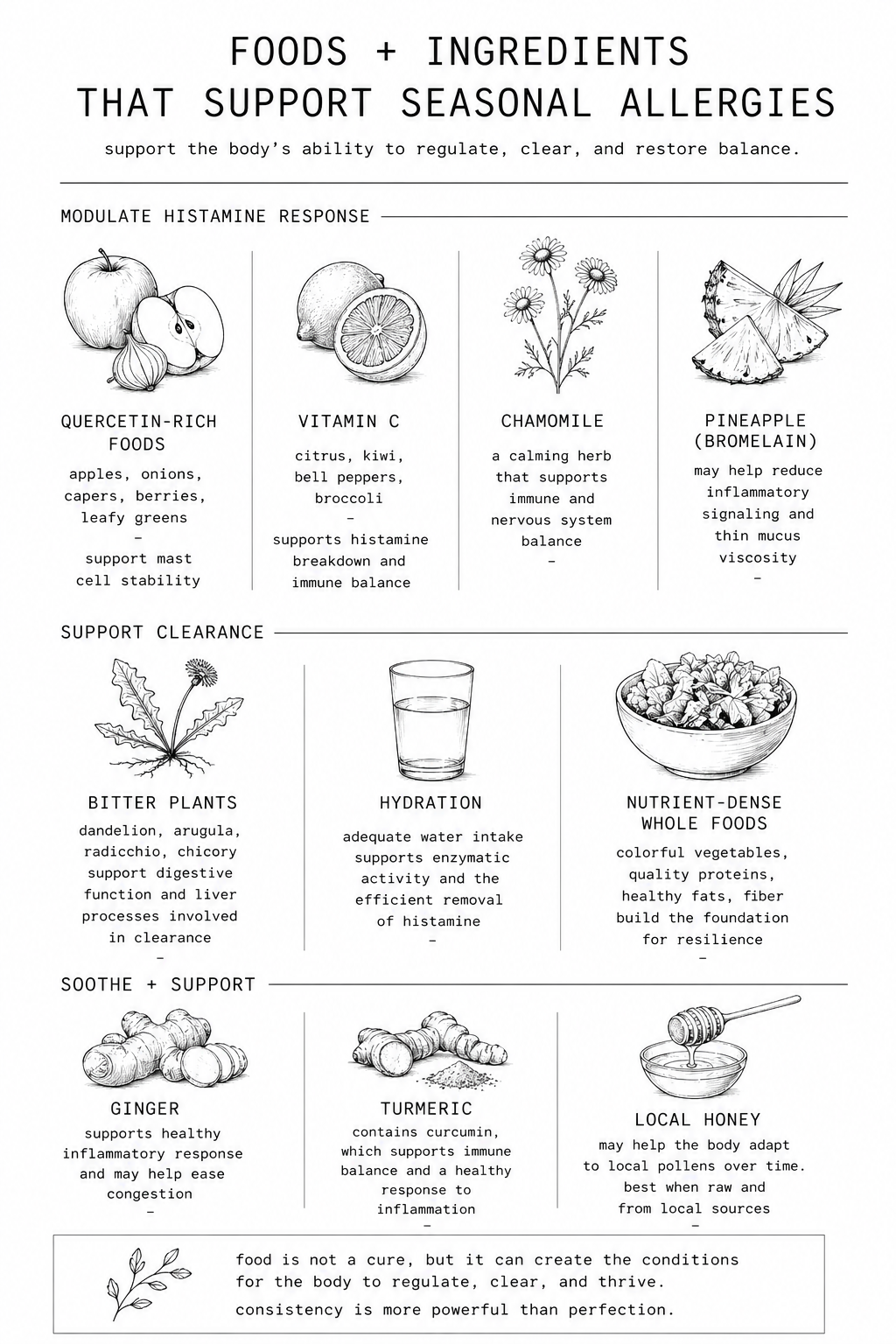
Supportive inputs include:
Quercetin-rich foods (apples, onions, capers) → support mast cell stability
Vitamin C → assists in histamine breakdown
Chamomile → calms both immune and nervous system activity
Pineapple, through its bromelain content, offers additional support by helping reduce inflammatory signaling and easing mucus viscosity.
These are not interventions of force—
but of subtle redirection.
02 — The Role of Clearance
Histamine is not inherently the problem.
It is a necessary signaling molecule involved in immune response.
What shapes the experience of allergies is not only how much histamine is released,
but how efficiently it is broken down and cleared.
This process relies on enzymatic activity throughout the body, including pathways supported by the liver.
When clearance is slower, histamine lingers—
prolonging swelling, congestion, and reactivity.
Support for this process may include:
Adequate hydration
Bitter plants such as dandelion
Nutrient-dense, whole foods
Reducing unnecessary load during peak exposure periods
The goal is not to “detox,”
but to support what the body is already designed to do.
The body does not only release histamine—
it must also clear it.
03 — Reducing Total Load
One of the most effective strategies is also the simplest:
Reduce what the body has to process.
Small, consistent actions:
Rinsing nasal passages (saline spray or irrigation)
Showering after outdoor exposure
Changing pillowcases frequently
Keeping windows closed during high pollen periods
These practices reduce incoming allergen load—
often with more impact than more complex interventions.
04 — Supporting Barrier Integrity
A compromised barrier—whether in the skin or nasal passages—
becomes more reactive, more permeable, and less resilient.
Dryness, over-cleansing, and environmental stress all contribute.
Barrier support looks like:
Maintaining hydration
Avoiding unnecessary irritation
Reinforcing with lipids where appropriate
This is not about adding more—
but about preserving what is already protective.
05 — Encouraging Movement
The lymphatic system is responsible for clearing excess fluid and cellular waste,
yet it relies entirely on movement.
Without it, stagnation builds.
While facial massage does not directly drain the sinuses,
it supports:
Lymphatic circulation
Venous return
Reduction of pressure and fluid accumulation
Light, intentional touch—whether with hands or gua sha—
can significantly shift the experience of congestion.
When fluid moves, pressure softens.
06 — Creating Conditions for Clearance
Simple, well-timed practices often create the greatest shift:
Saline spray or rinse before a hot shower
Steam exposure to loosen mucus
Followed by gentle facial drainage techniques
This sequence works with the body’s natural processes—
preparing, softening, and guiding movement.
A Different Approach
This is not about eliminating symptoms entirely.
It is about reducing resistance within the system.
When inflammation is moderated,
when barriers are intact,
when fluid is moving—
the body responds with less urgency.
Softer.
More regulated.
More capable of adapting to the environment it exists within.
Closing
Seasonal shifts will always ask more of the body.
But when the systems responsible for processing, protecting, and clearing are supported—
the experience changes.
Not by force,
but by function.
If you’re navigating seasonal shifts and feeling the effects in your skin or sinuses,
this is often where gentle, consistent support creates the most meaningful change.