
Finding Your Sunscreen Match
Why the best sunscreen is not the same for everyone
In my previous article, Sunlight, Skin, and Balance, we explored how sunlight interacts with the skin, the role of oxidative stress, and why protection matters. We discussed ultraviolet radiation, antioxidants, barrier function, and the body's remarkable ability to repair itself. We also acknowledged something important: sunlight is not inherently harmful, nor should it be feared.
What we did not discuss is perhaps the question I am asked most often:
"Which sunscreen should I use?"
The answer is rarely simple.
After more than two decades of working with skin, I have found that sunscreen selection is incredibly personal. A formula that feels beautiful on one person may feel heavy, drying, or irritating on another. Some clients are focused on pigmentation. Others are concerned with sensitivity, barrier repair, or finding something that wears well beneath makeup.
Not every sunscreen excels in the same areas.
The best choice depends on your skin, your goals, and how you like your sunscreen to feel.
Before we talk about specific products, I think it is helpful to understand what I personally look for when evaluating a sunscreen.
What I Personally Look For in a Sunscreen
Non-Nano Zinc Oxide
Zinc oxide remains my preferred UV filter.
It provides broad-spectrum protection against both UVA and UVB radiation and is generally well tolerated by many skin types. While both mineral and chemical sunscreens can be effective, I often find myself gravitating toward zinc oxide-based formulas, particularly for sensitive, reactive, or treatment-focused skin.
I personally seek out formulations that utilize non-nano zinc oxide. While the conversation surrounding particle size is nuanced, I appreciate formulations that prioritize larger particles that remain on the skin's surface while still providing elegant protection.
For many clients, it offers a balance of effectiveness, gentleness, and simplicity.
Formula Stability
This is one of the most overlooked aspects of sunscreen selection.
A sunscreen is only effective if the active ingredient remains evenly distributed throughout the formula and forms a consistent protective film across the skin.
This requires thoughtful formulation, proper testing, and manufacturing practices that ensure consistency from the first application to the last.
Within the natural skincare space, this is particularly important. A beautiful ingredient list does not automatically translate to effective protection. A sunscreen can contain organic oils, botanical extracts, and nourishing ingredients, but if the zinc oxide is not properly dispersed or the formula is unstable, performance may suffer.
This is one area where some natural sunscreens excel and others miss the mark.
Visible Light Protection
One of the most significant shifts in recent years has been our understanding of visible light and pigmentation.
For individuals prone to melasma, post-inflammatory hyperpigmentation, or stubborn discoloration, visible light can contribute to ongoing pigment formation.
This is where iron oxides become valuable.
Often found in tinted sunscreens, iron oxides help provide protection against visible light in ways traditional UV filters alone cannot.
Not everyone requires this level of support, but for pigmentation-prone skin, it can be a meaningful consideration.
Barrier-Supportive Ingredients
I appreciate sunscreens that contribute something beyond protection.
Ingredients such as ceramides, fatty acids, antioxidants, and nourishing plant oils can help support comfort throughout the day, particularly for those experiencing dryness, sensitivity, or barrier impairment.
For some individuals, sunscreen is the final step in a routine. When that product can simultaneously support the skin barrier, it becomes more than a protective layer—it becomes part of the overall treatment strategy.
Thoughtful Sourcing
Whenever possible, I gravitate toward products that utilize thoughtfully sourced ingredients, including organic plant oils and botanical extracts.
Not because organic automatically means better, but because ingredient sourcing often reflects the overall philosophy of a brand.
I appreciate companies that prioritize transparency, quality, and responsible formulation practices.
Cosmetic Elegance
This may be the most important category of all.
The most protective sunscreen in the world offers little benefit if it sits untouched on a bathroom shelf.
Texture matters.
Finish matters.
How a sunscreen feels on your skin matters.
A sunscreen that integrates seamlessly into your routine is far more valuable than one that you avoid because it feels heavy, greasy, drying, or difficult to wear.
Consistency will always outperform perfection.
There Is No Perfect Sunscreen
One of the biggest misconceptions in skincare is the belief that there is a universally "best" sunscreen.
What I have learned is that every formula involves trade-offs.
Some offer exceptional visible light protection but feel heavier on the skin. Others prioritize simplicity and barrier support. Some wear beautifully beneath makeup, while others appeal to those seeking a more natural, botanical approach.
Natural does not automatically mean superior, just as synthetic does not automatically mean harmful.
I have seen beautifully formulated natural sunscreens and poorly formulated natural sunscreens. Likewise, I have seen sophisticated conventional formulas that perform exceptionally well.
My goal is not to choose sides.
My goal is to evaluate how effectively a product protects the skin and how comfortably it integrates into daily life.
Rather than searching for the perfect sunscreen, I encourage clients to find the sunscreen that best aligns with their individual needs.
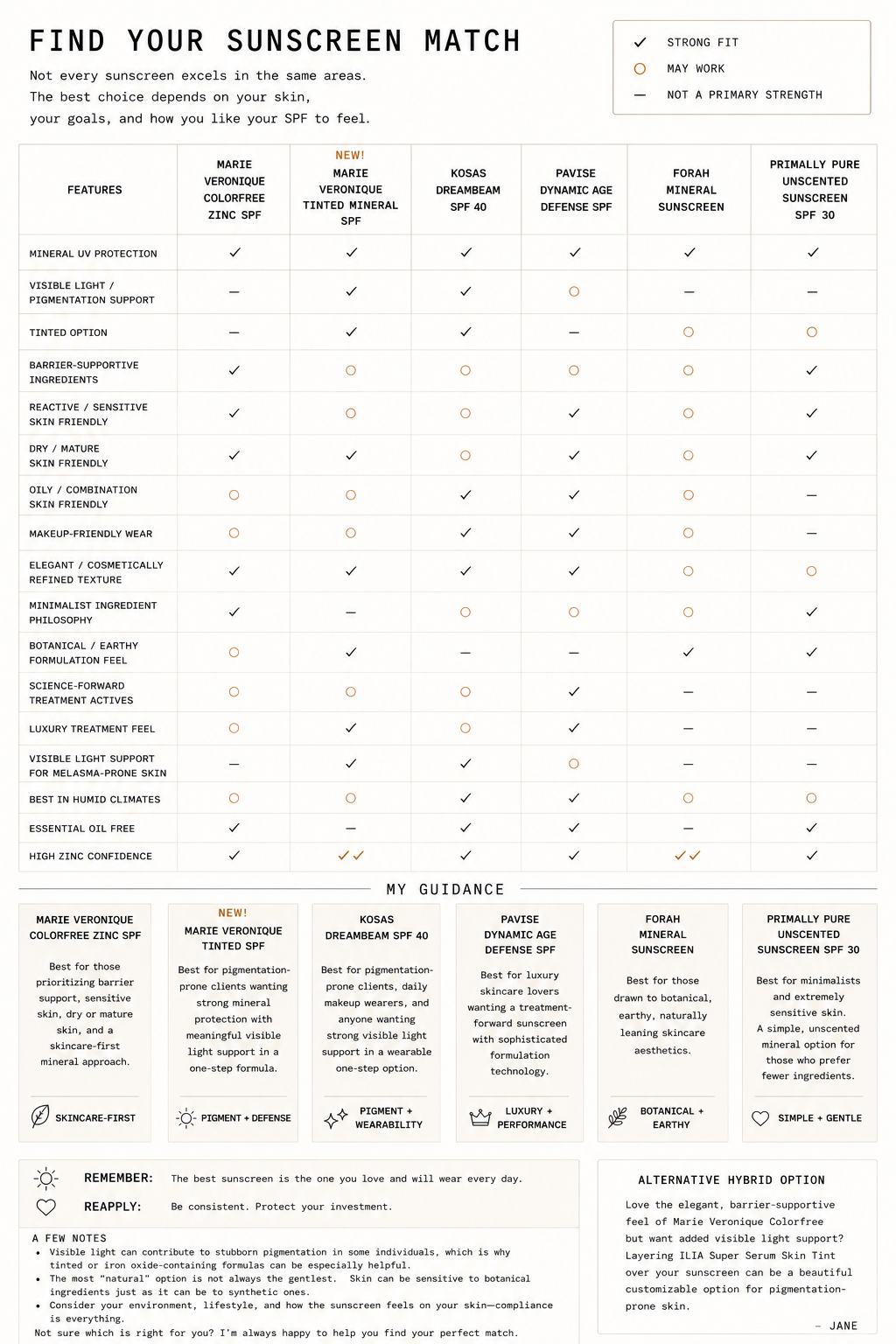
The chart below is the framework I use when helping clients navigate those choices.
Is Higher SPF Always Better?
This may surprise some people, but not necessarily.
An SPF 30 blocks approximately 97% of UVB radiation, while SPF 50 blocks approximately 98%.
Although higher SPF can be beneficial in certain circumstances, the difference is often smaller than consumers realize.
I am often more interested in whether a sunscreen is worn consistently, applied generously, and reapplied appropriately than whether the number on the bottle is SPF 30 or SPF 50.
A beautifully formulated SPF 30 that you wear every day is often a better choice than an SPF 50 that never leaves the bathroom counter.
A Few Things Worth Remembering
If you are prone to melasma or stubborn pigmentation, consider formulas that contain iron oxides and provide visible light support.
If your skin is reactive or easily irritated, simplicity often wins. More ingredients do not necessarily create a better sunscreen.
If you spend long days outdoors, prioritize generous application and reapplication over endlessly chasing higher SPF numbers.
If your skin is dry or mature, barrier-supportive ingredients can make sunscreen feel more comfortable and sustainable for daily wear.
If you wear makeup regularly, cosmetic elegance matters more than many people realize.
And finally:
The sunscreen you wear every day is infinitely more valuable than the sunscreen you only wear occasionally.
My Philosophy
I do not believe sunlight should be feared.
I also do not believe protection should be an afterthought.
The goal is not to hide from the sun. The goal is to understand how it interacts with the skin and to respond thoughtfully.
Choose protection that feels sustainable.
Choose formulas that support your skin's unique needs.
Choose products you genuinely enjoy wearing.
Because the best sunscreen is not the one with the loudest marketing.
It is not the one with the highest SPF number.
And it is not necessarily the one that works for someone else.
The best sunscreen is the one that becomes part of your daily life.
The one you trust.
The one you reach for consistently.
The one that allows you to enjoy sunlight while supporting the long-term health of your skin.
Balance has always been the goal.
This is simply another way to practice it.
While no sunscreen is perfect, each of the formulas included in this guide brings something valuable to the conversation. Some prioritize barrier support, others visible light protection, cosmetic elegance, or ingredient simplicity.
The chart is not intended to declare a winner, but rather to help identify which formula may be the best fit for your skin, your concerns, and your lifestyle.
For those interested, below is a brief overview of the sunscreens referenced throughout this guide.
Products Referenced in This Guide
Marie Veronique Colorfree SPF
A thoughtfully formulated mineral sunscreen centered around non-nano zinc oxide. What stands out most is its barrier-supportive approach, making it an excellent option for sensitive, dry, or treatment-focused skin. The finish is natural and elegant, though those seeking visible light protection for pigmentation may prefer a tinted option.
Marie Veronique Tinted SPF
The tinted counterpart to the Colorfree formula. In addition to zinc oxide protection, the inclusion of iron oxides offers support against visible light, making it a strong choice for those concerned with melasma or hyperpigmentation. It maintains the sophisticated, skin-supportive philosophy Marie Veronique is known for.
Kosas DreamBeam
A mineral sunscreen that beautifully bridges skincare and makeup. The peach-toned tint contains iron oxides for visible light protection while providing a healthy, natural finish. I often recommend it to clients looking for a sunscreen that feels wearable and cosmetically elegant for everyday use.
FORAH SPF 25
A mineral sunscreen with a botanical-forward philosophy and a beautiful sensory experience. It wears comfortably, layers well with skincare, and appeals to those seeking a more natural approach. While the SPF is lower than some formulas, it is one I enjoy for everyday wear when consistent application is realistic.
Primally Pure SPF
A minimalist mineral sunscreen formulated with nourishing oils and butters. It aligns well with those who appreciate ingredient simplicity and a more traditional natural skincare aesthetic. It can be particularly appealing for dry skin, though the richer texture may not suit everyone.
Pavise Dynamic Age Defense SPF
One of the more science-forward formulas on the market. While it does not align perfectly with my preference for simpler ingredient decks, I appreciate the thought process behind the formulation. Its focus on visible light, pigmentation concerns, and environmental stressors makes it an interesting option for individuals managing melasma or stubborn discoloration.