
Does Your Environment Really Change Your Skincare?
Every change in season seems to bring a new set of skincare rules. Summer calls for lighter products, winter demands richer creams, and social media constantly reminds us to rotate our routines as though our skin becomes something entirely different every few months. It's easy to believe that the weather should dictate the products we use.
The more time I spend studying skin, however, the less I believe that's true.
Our environment absolutely influences our skin, but it doesn't change what the skin is fundamentally trying to accomplish. Whether you live in the high humidity of the Gulf Coast, the dry heat of the desert, or somewhere in between, your skin wakes up every morning with the same objective: to maintain balance. Every moment of the day it is regulating water, strengthening its barrier, defending itself from environmental stress, repairing microscopic damage, and constantly adapting to the world around it. The environment doesn't change those priorities—it simply changes how much support the skin needs to carry them out.
That shift in thinking has completely changed the way I approach skincare. I don't build routines around the seasons. I build them around physiology. Instead of asking what products belong in summer or winter, I ask a much simpler question: What does my skin need to function well in the environment it's in today?
Take summer as an example. Many people assume that because the air feels heavy with moisture, their skin should naturally feel hydrated. Yet one of the most common concerns I hear this time of year is, "My skin feels so dry, but I don't understand how that's possible when it's so humid outside."
The answer lies in understanding the difference between humidity and hydration.
Humidity describes the amount of water in the air. Hydration refers to the amount of water held within the skin itself. While humid air can slow the rate at which water evaporates from the surface of the skin, it cannot replace water that has already been lost, nor can it compensate for a skin barrier that has become compromised. In other words, humidity may create a more supportive environment, but it doesn't hydrate the skin on its own.
This distinction becomes even more important when we consider how we actually live. We often think of summer as one environment, yet our skin experiences many before the day is over. We move from humid sidewalks into air-conditioned cars, from brightly lit offices back into the afternoon sun, from workouts and showers to grocery stores kept at refrigerator temperatures. Every transition changes the temperature, humidity, airflow, and ultraviolet exposure surrounding the skin, requiring it to make continual adjustments in order to maintain equilibrium.
The remarkable thing is that healthy skin is designed to do exactly that. Adaptation is one of its greatest strengths, but adaptation isn't effortless. Every response requires energy, water, structural lipids, antioxidants, and an intact barrier capable of responding to change without becoming overwhelmed. When those resources begin to run low, the skin often tells us long before we notice anything visible. It may feel tight after cleansing, become more reactive than usual, or suddenly seem oily while still feeling dehydrated beneath the surface. Rather than seeing these as isolated problems to fix, I think they're often better understood as signals that the skin is asking for support.
This is one of the reasons I encourage clients to become observers of their skin rather than followers of seasonal trends. The calendar doesn't know whether you've spent the last week on an airplane, sitting beneath office air conditioning, hiking in the mountains, or walking through ninety-degree heat. Your skin does. When we begin paying attention to how it responds to its environment instead of assuming what it needs based on the season, our routines become much more thoughtful—and often much simpler.
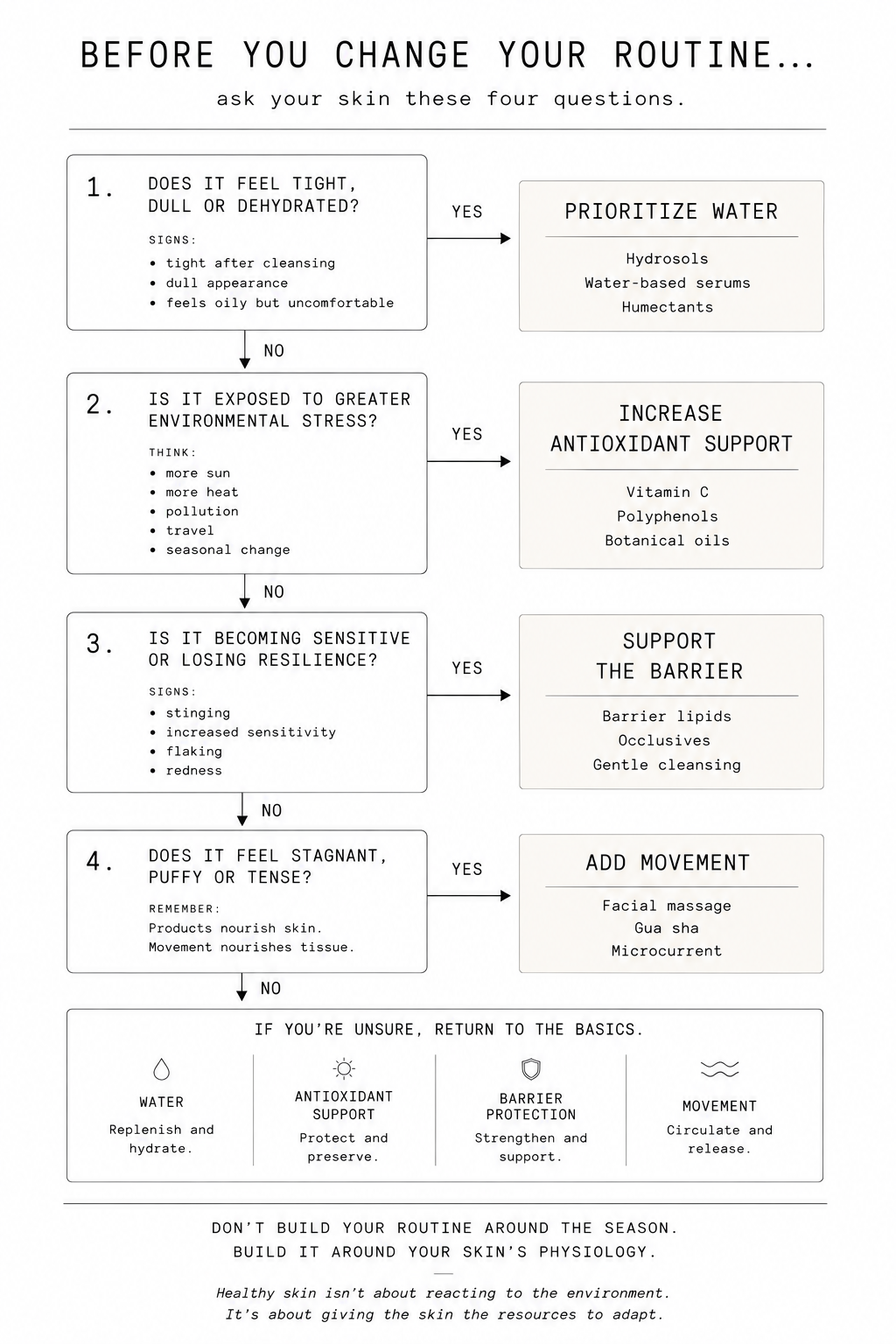
The question, then, isn't whether your environment changes your skincare. It certainly influences it. The more useful question is how we can give the skin the resources it needs to continue doing what it has always been designed to do: adapt.
If we begin thinking about skincare through the lens of physiology rather than seasons, the next question becomes surprisingly simple: What does the skin need to function well?
The first answer is almost always water.
One of the biggest misconceptions in skincare is that dry skin automatically needs more oil. While oils, balms, and richer creams certainly have an important role, they cannot replace water that isn't there to begin with. Water is the medium in which many of the skin's most important processes occur. The enzymes responsible for normal exfoliation depend on it. Barrier repair depends on it. Even the communication between skin cells functions more efficiently when adequate hydration is present. When water becomes limited, the skin doesn't simply feel dry—it becomes less efficient at doing the very things that keep it healthy.
Once we understand that, it changes the order in which we approach skincare. Rather than immediately trying to seal the skin, it makes sense to first replenish the water that has been lost through normal daily living. Heat, ultraviolet exposure, repeated cleansing, air conditioning, wind, and low humidity can all increase transepidermal water loss, which is simply the gradual evaporation of water from the skin. Despite its intimidating name, this isn't something we want to eliminate entirely. Healthy skin is designed to lose a small amount of water every day. The goal is simply to prevent that loss from exceeding the skin's ability to replace it.
Water, however, is only one part of the equation.
As the skin works to adapt to its environment, it also has to defend itself against the oxidative stress created by sunlight, heat, pollution, and normal cellular metabolism. We often hear antioxidants discussed in the context of anti-aging, but I think their role is far more fundamental than that. Oxidative stress doesn't simply contribute to wrinkles over time; it can also affect the lipids that make up the skin barrier, making it more difficult for the skin to retain water and maintain its resilience. I think of antioxidants less as corrective ingredients and more as daily support for healthy skin function. They're helping preserve the environment the skin needs in order to do its job well.
The barrier itself deserves its own conversation because we often use words like hydrating, moisturizing, and barrier repair interchangeably, even though they describe very different things. Hydration is about water. Barrier lipids help organize the skin's protective structure and regulate the movement of that water. Occlusive ingredients then help slow unnecessary water loss by creating a protective layer over the surface. Understanding those distinctions allows us to choose products with far more intention. Instead of searching for "the best moisturizer," we can begin asking whether our skin is asking for water, structural support, or simply help holding onto what it already has.
There's one final piece that I think deserves far more attention than it receives, and that's movement.
One of the things I say most often in my treatment room is that movement can often do more for the skin than another product. Products create a supportive environment, but they cannot create circulation, encourage lymphatic flow, relieve muscular tension, or maintain the mobility of the tissues beneath the skin. Those are benefits that come from touch. Whether it's two minutes of thoughtful facial massage while applying your evening products or a longer ritual a few times each week, movement reminds us that skincare is something we participate in, not simply something we purchase.
When we begin looking at the skin this way, our routines become much less complicated. Rather than replacing every product each time the weather changes, we simply adjust the support we're giving the systems that are working hardest. A humid summer may increase the skin's need for antioxidant support while still leaving it dehydrated from heat, cleansing, and air conditioning. A dry winter may require more attention to water retention and barrier protection. The principles remain the same; only the demands change.
The longer I work with skin, the less I believe healthy skin comes from following seasonal trends or chasing the newest ingredient. Instead, I believe it comes from understanding what the skin has been trying to do all along and giving it the resources to do it well. Our environment will always change. The seasons will continue to come and go. We can't control the weather, but we can learn to support the remarkable organ that adapts to it every single day.
Perhaps that's the question worth asking the next time your skin feels different.
Not, "What season is it?"
But rather, "What is my skin asking for today?"